Obsession / Trauma / Good Luck: Diaspora
April 4 -26, 2026
Opening: Saturday, April 4, 2026 (6-8 pm)
Artists: Tai Hwa Goh, Jiyoun Lee-Lodge, Joo Yeon Woo
Curated by Soojung Hyun
Artist Talk Details
Date: Sunday, April 19, 2026
Time: 5:00–6:00 PM (Eastern Time)
Format: Zoom
Participating Artists:
Tai Hwa Goh, Jiyoun Lee-Lodge, Yoo Yeon Woo
Moderator / Curator:
Soojung Hyun
This conversation will explore the layered psychological and emotional dimensions of diaspora as reflected in the artists’ works. Together, we will engage with themes of memory, adaptation, and hope as a form of positivity and resilience—the capacity to endure and move toward renewal. It promises to be a deeply insightful session on how art navigates the complexities of cultural and personal identity.
Join Zoom Meeting
https://us02web.zoom.us/j/
Meeting ID: 844 2420 8414
Passcode: 037657
Obsession / Trauma / Good Luck: Diaspora
Migration is not framed as a linear narrative of departure and assimilation, nor as a simple arc of loss followed by recovery. Instead, it emerges as a condition of perpetual negotiation—a shifting terrain where inheritance and reinvention continuously collide. To migrate is not merely to move across geography; it is to live inside translation. It is to inhabit the space between what was carried and what must be reconfigured.
Nothing survives the crossing intact. Memory is edited. Language is bent. Identity is rehearsed in fragments. Some histories are disguised for protection; others are withheld to endure. What appears seamless on the surface often conceals complex negotiations beneath. In this context, diaspora is not only displacement but also choreography—a careful calibration of exposure and concealment.
The title Obsession / Trauma / Good Luck names three interwoven states that structure the diasporic psyche.
Obsession marks the compulsive return to memory, language, and the image of origin. It stabilizes the present even as it destabilizes it, drawing the mind backward while life insists on adaptation.
Trauma signals rupture—the fracture of belonging and the disruption of narrative continuity. It resides not only in dramatic historical events but in quieter dislocations: subtle erasures, misrecognitions, and the quiet recalibration of self within unfamiliar systems of power. Trauma folds time; the past does not remain past but returns unexpectedly.
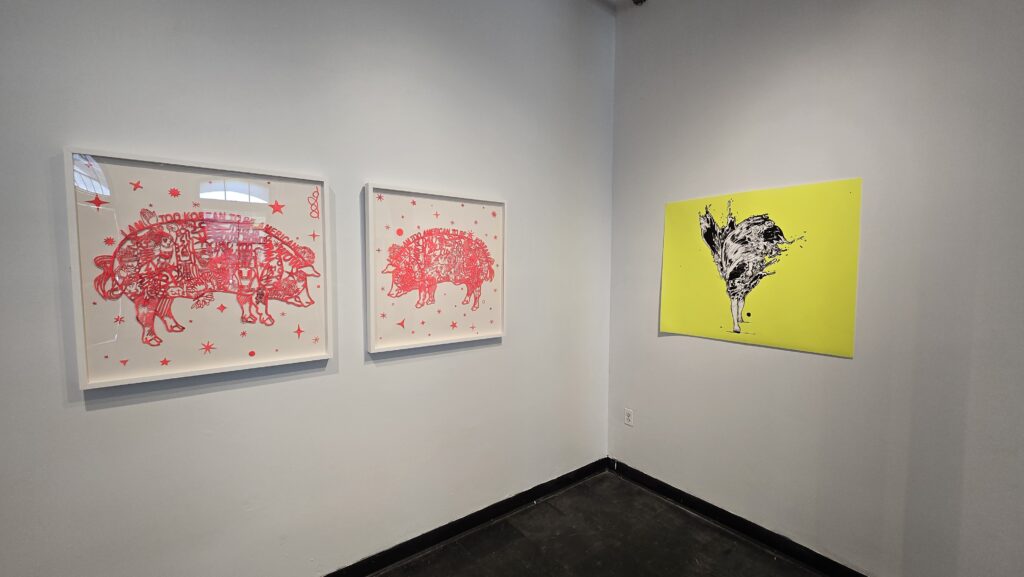
Good Luck may sound ironic—improbable, even absurd, like pigs flying over one’s blood. Yet within diasporic experience, luck is not naïve optimism. It is a fragile, defiant belief that adaptation may open unforeseen paths. It is the quiet gamble that survival might generate renewal.
These forces do not unfold sequentially. They overlap, coexist, and contradict one another. Obsession can deepen trauma; trauma can sharpen survival; survival can make room for improbable grace. Like layered transparencies, they surface and recede without ever fully resolving.
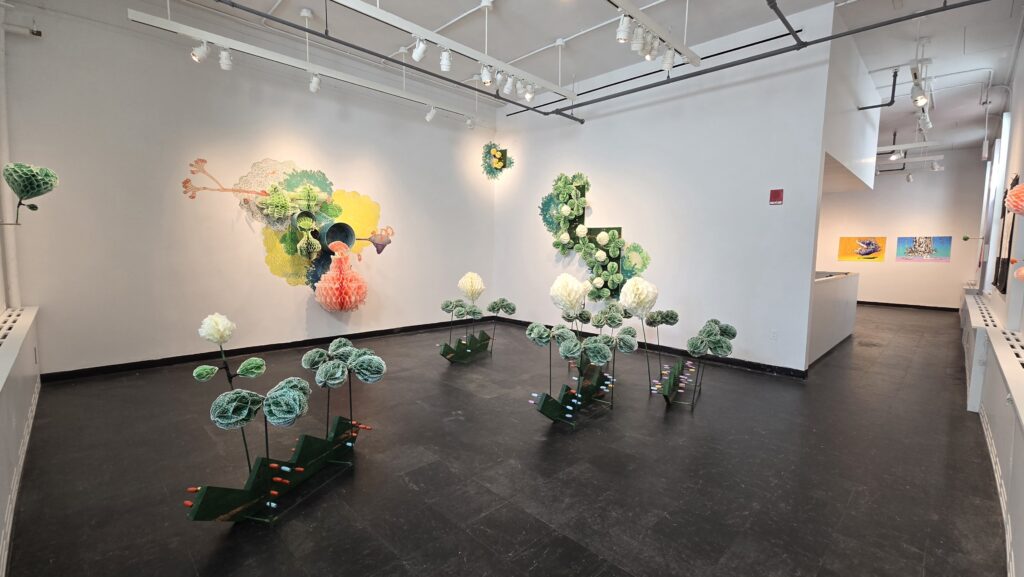
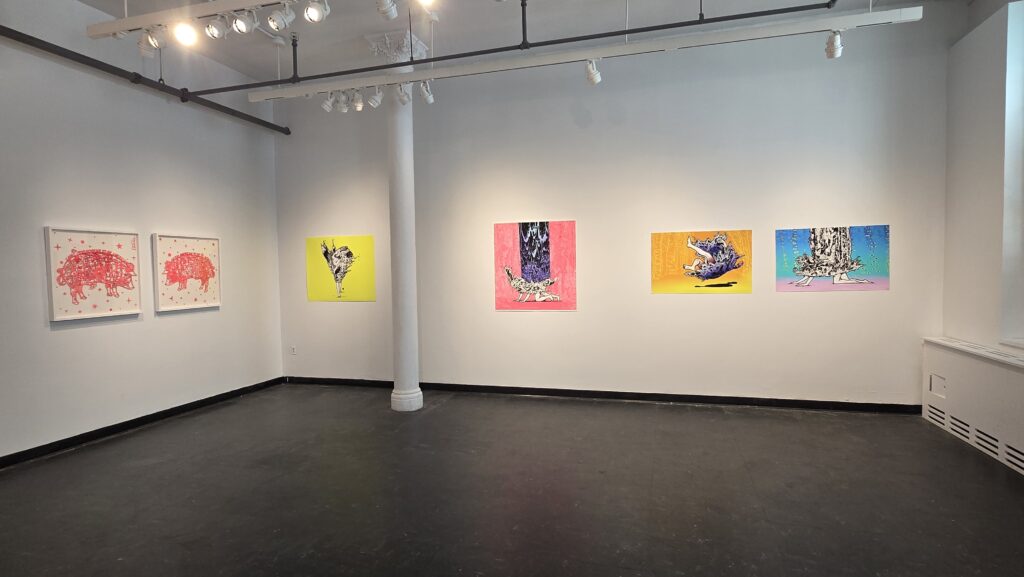
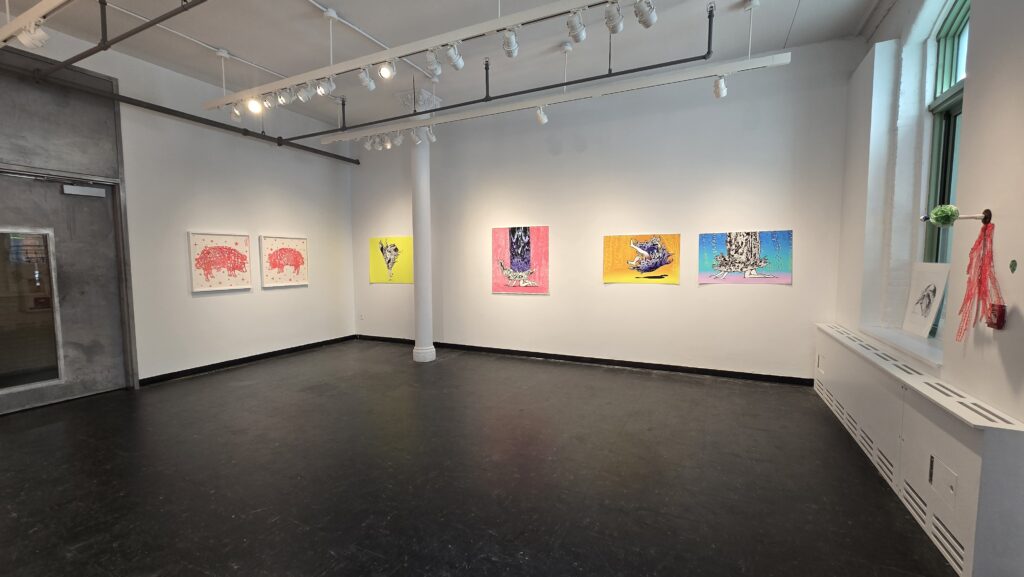
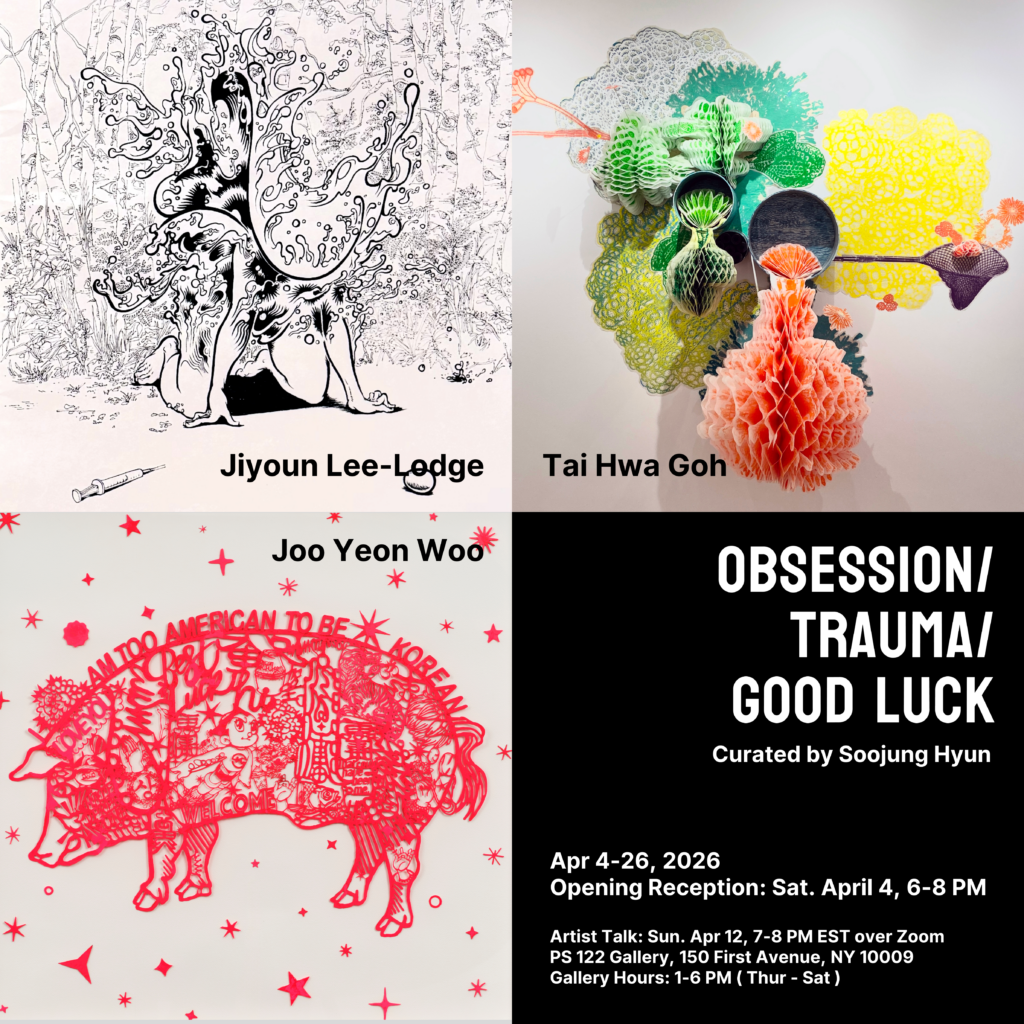
Bringing together Korean-born artists Tai Hwa Goh, Jiyoun Lee-Lodge, and Joo Yeon Woo, the exhibition operates across digital, political, and organic registers. Through drawing, cut-paper installation, sculptural hanji structures, and immersive spatial gestures, the works transform personal histories into shared environments of resilience. Each work negotiates visibility differently.
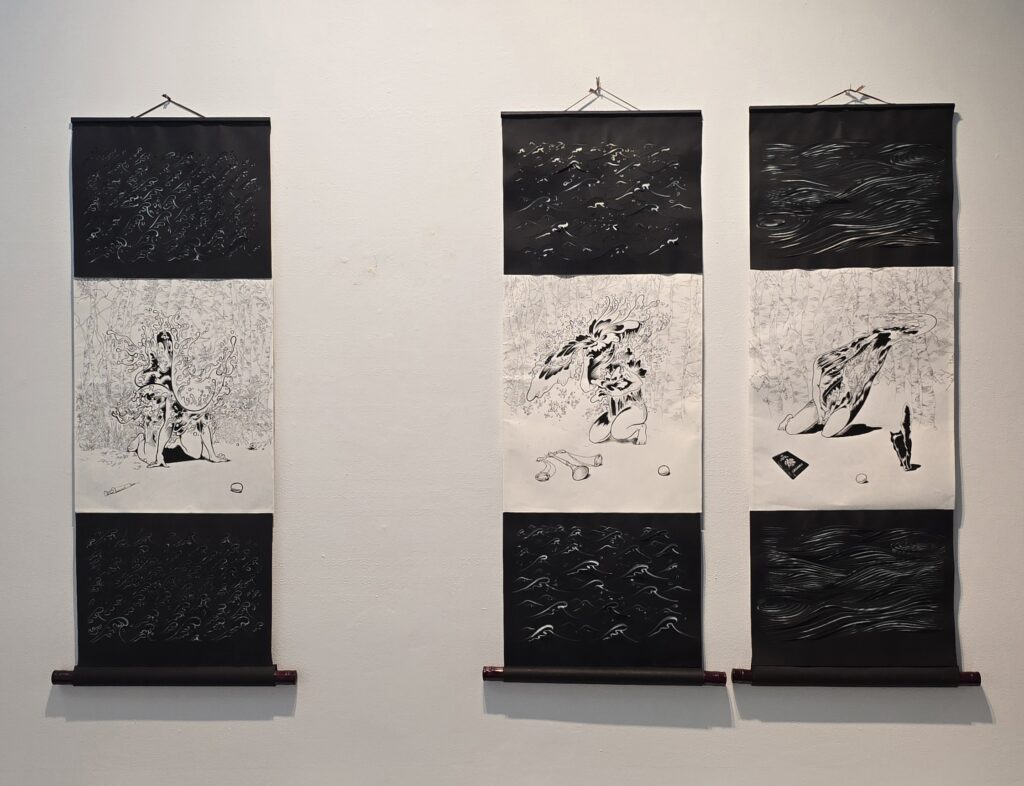
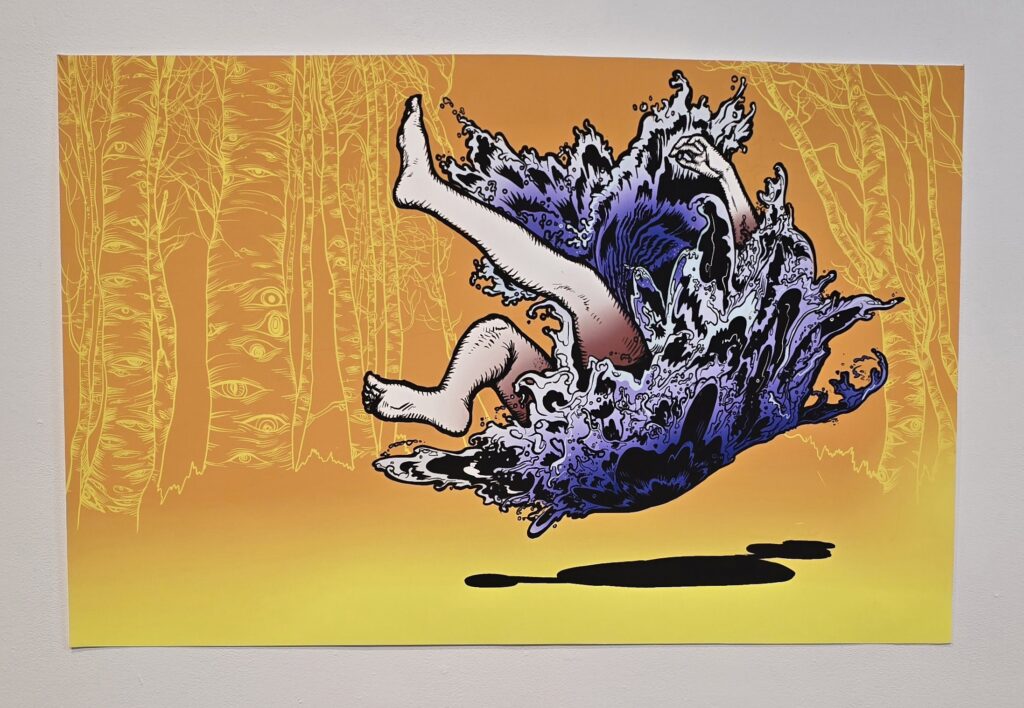
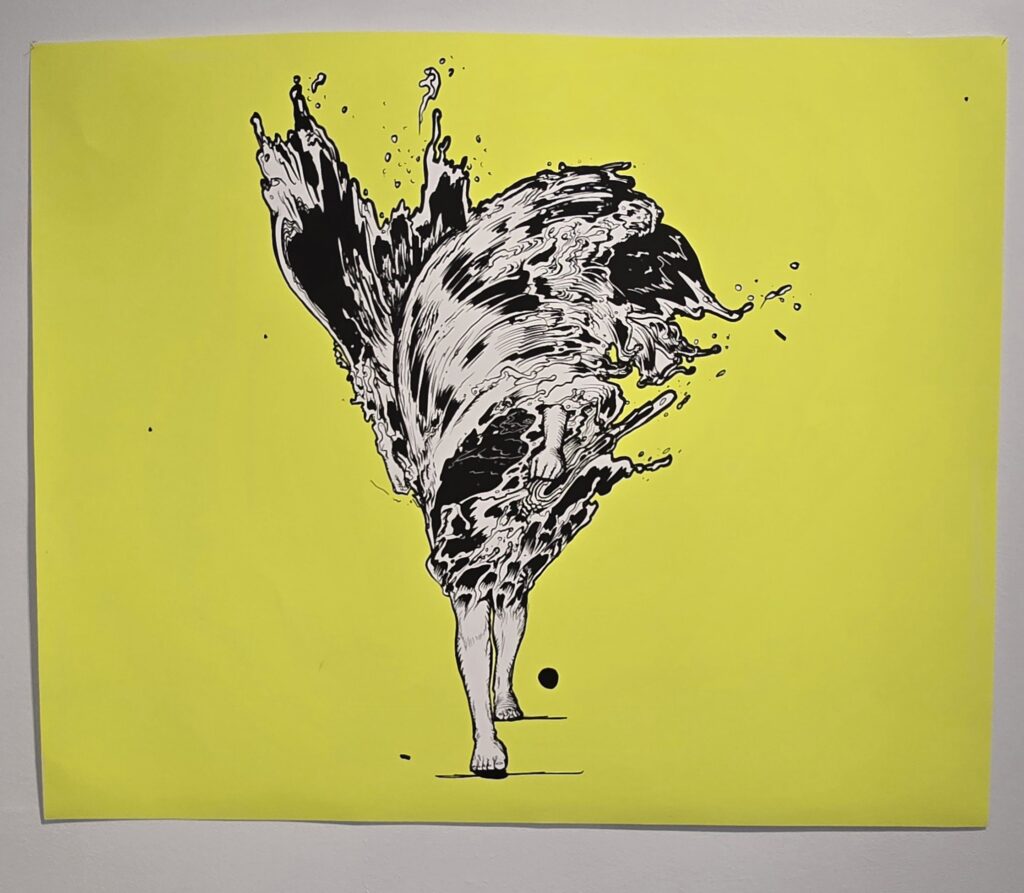
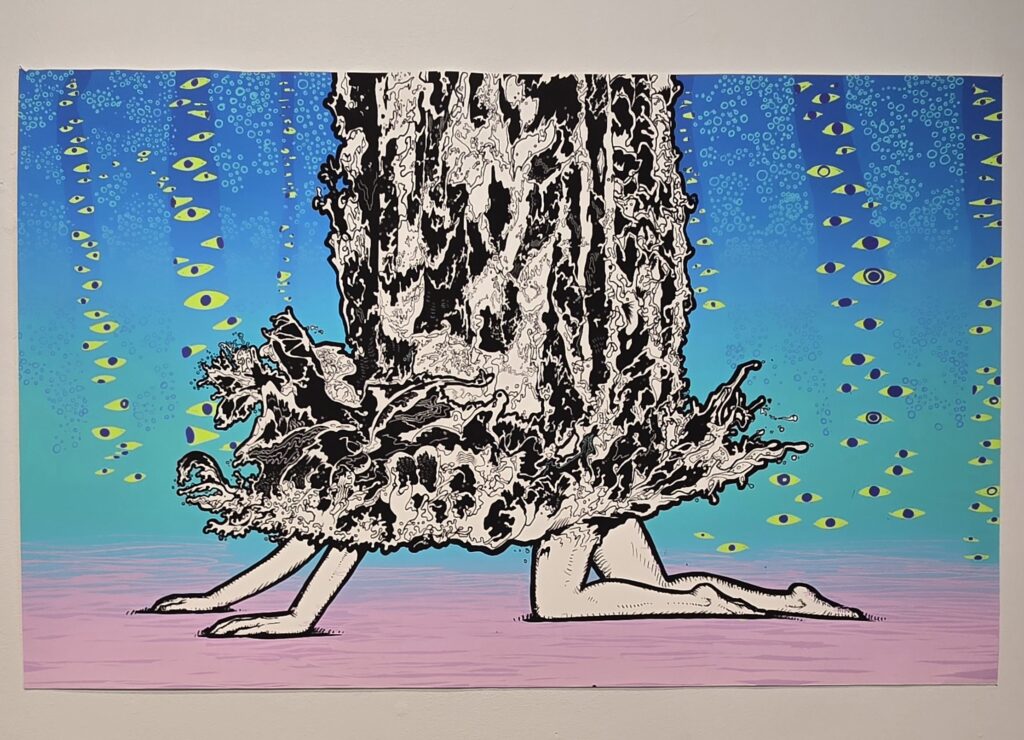
Jiyoun Lee-Lodge explores the evolving self shaped by artificial intelligence and social media. Drawing from her background in animation and game concept design, her work combines visual precision with a fluid non-figurative sensibility. Digitally fractured bodies dissolve and reassemble, reflecting how identity is performed and recalibrated within algorithmic systems. Her work reveals the paradox of hyper-visibility: to be seen is also to be surveilled.
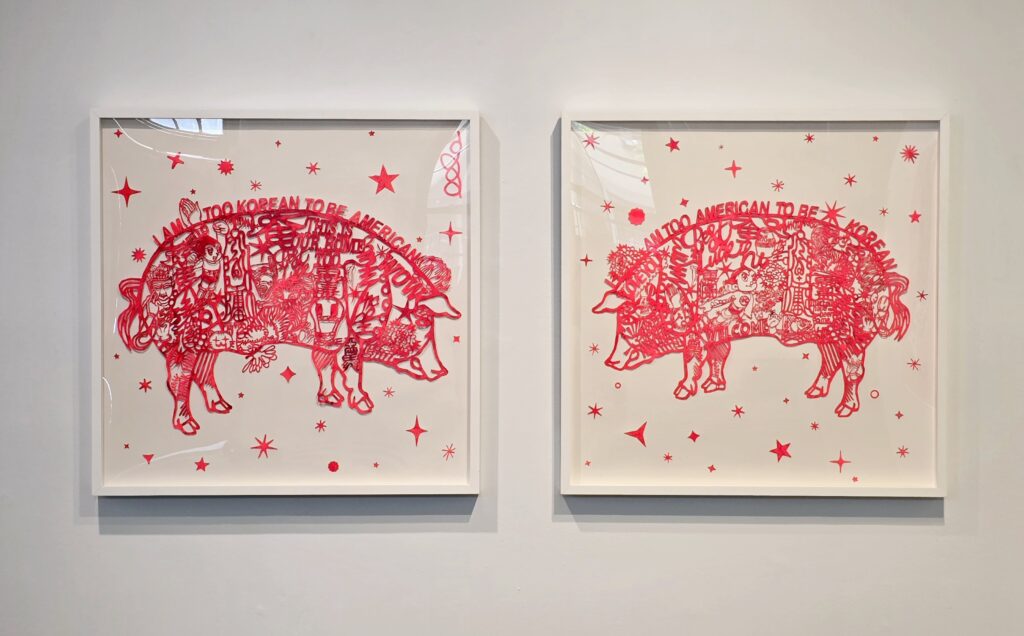
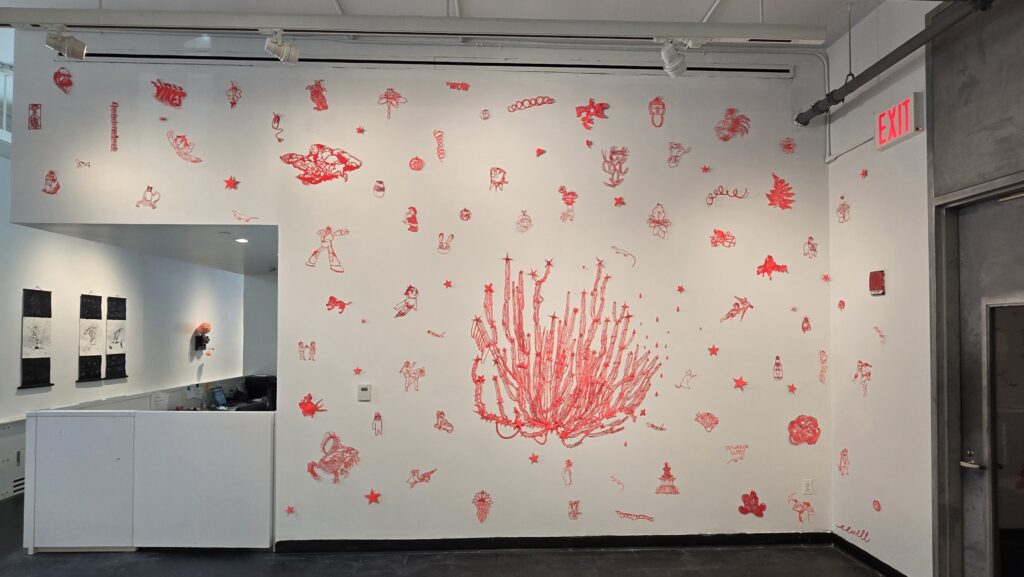
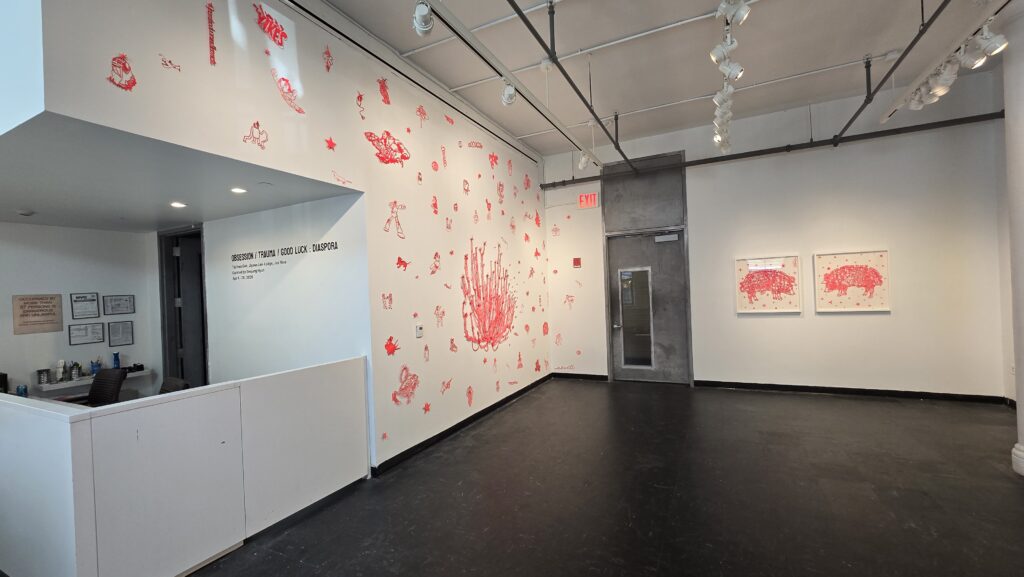
Joo Yeon Woo engages personal and historical archives connected to South Korea’s military dictatorship and her transnational life in the United States. Her red cut-paper installations weave together propaganda imagery, Buddhist amulets, children’s drawings, and protest typography. The act of cutting becomes both removal and preservation. The color red oscillates between ideology, danger, and protection, intensifying the tension between visibility and erasure.
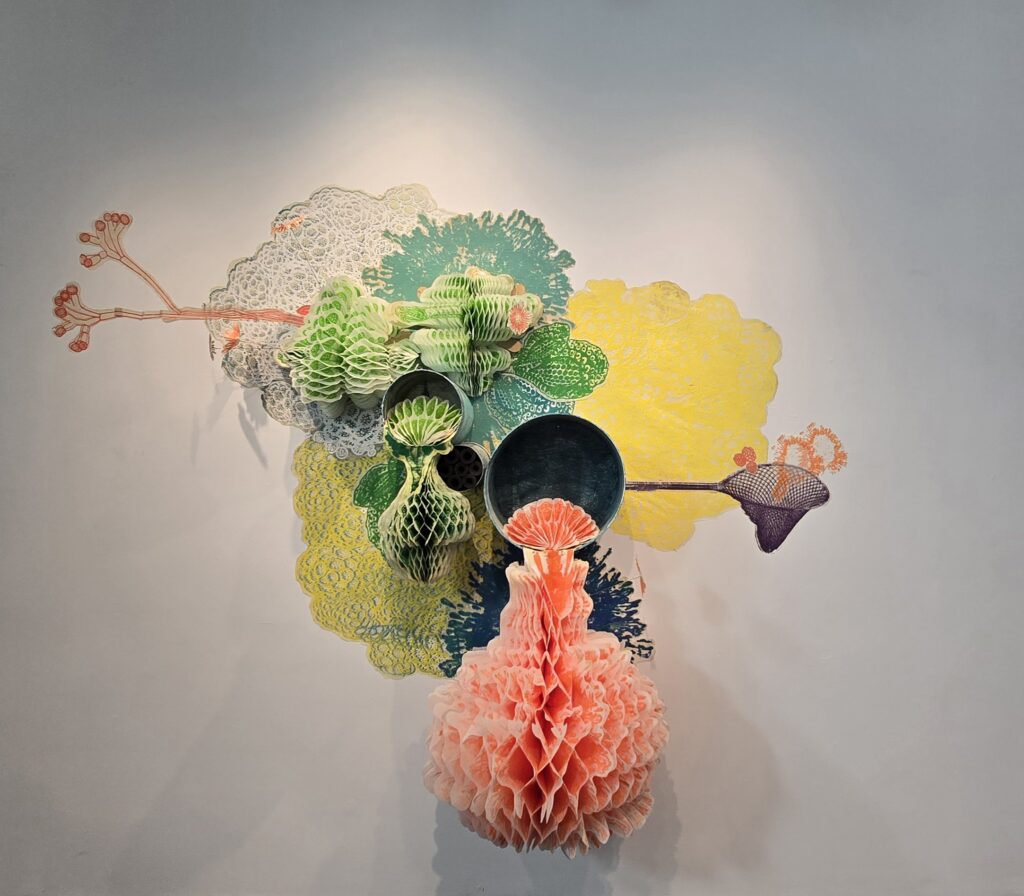
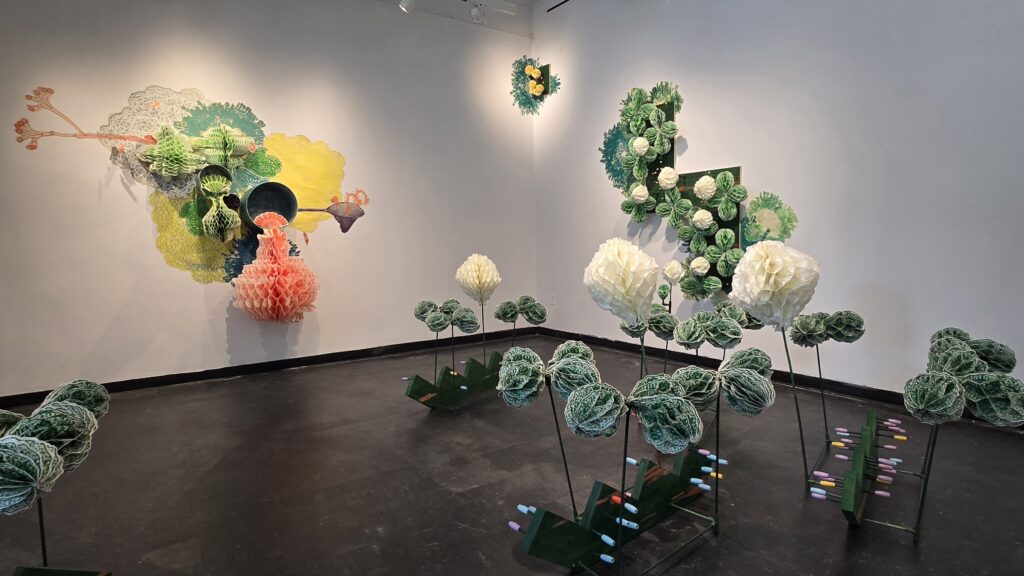
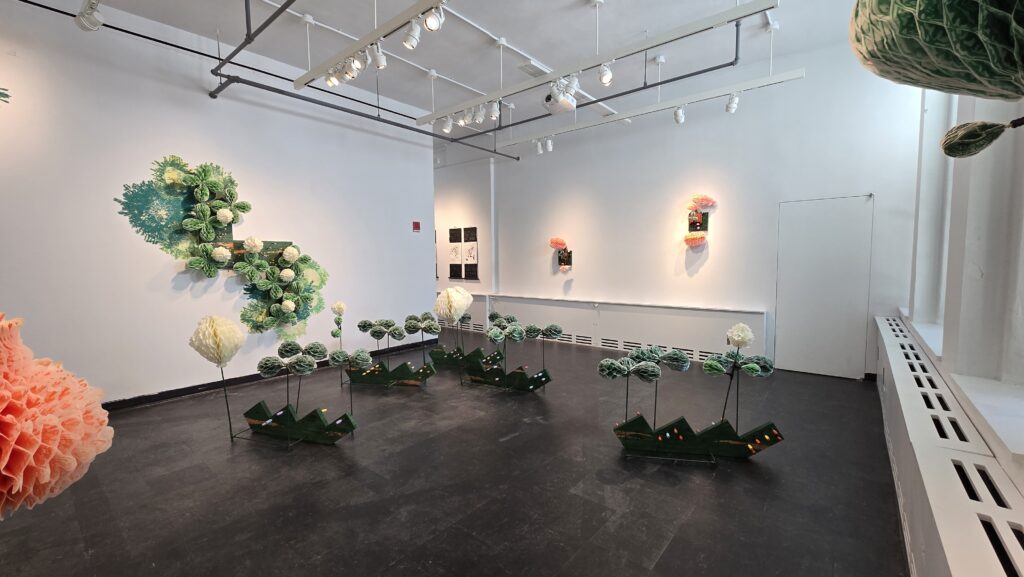
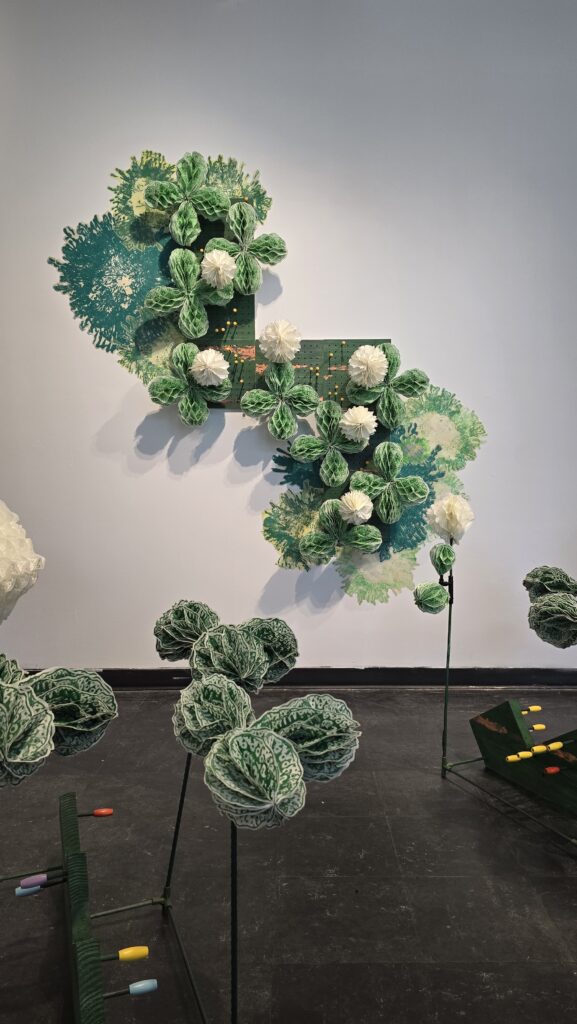
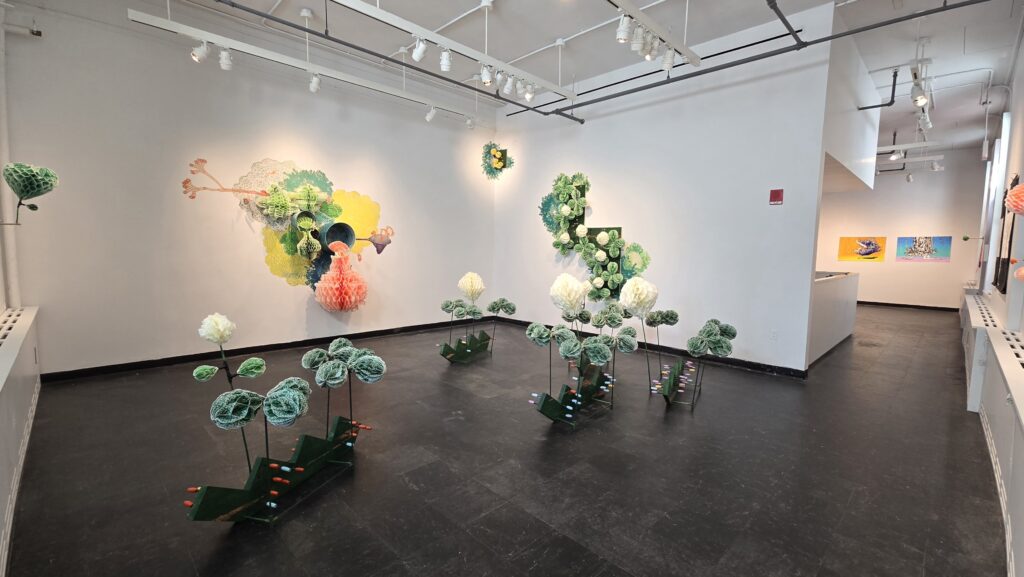
Tai Hwa Goh expands traditional printmaking into immersive sculptural environments using layered and sewn hanji. Inspired by everyday plants such as clovers—subtle emblems of luck—her porous structures evoke cycles of growth, fragility, and interdependence. Constructed through hand-pulled prints and intricate assembly, her installations resemble organic systems suspended between stability and collapse. Goh’s work suggests that hope survives not through certainty but through adaptation and quiet resilience.
The works in this exhibition do not simply illustrate migration—they inhabit it. They stage concealment and revelation, translating memory into material and vulnerability into form. Within these spaces, visibility is negotiated rather than assumed. Diaspora emerges not as a completed story but as an ongoing condition: a practice of survival shaped by obsession, marked by trauma, and sustained by improbable luck.
Artists Bio
Jiyoun Lee-Lodge is a Korean-born, Salt Lake City-based artist whose work explores the intersection of digital perception and human vulnerability. Drawing on her background in animation concept design, she creates narrative-driven paintings and public installations that investigate how AI and social media reshape our identity.
With an MFA from Brooklyn College and a decade of experience in the New York art scene, her work has been featured at UMOCA, the Southern Utah Museum of Art, and Gallery Mint in Seoul. Notable achievements include the permanent TRAX installation “The Crossing” and “Best in Show” at the Utah Statewide Annual. Her practice captures the friction between our physical lives and digital fabrications, visualizing the unseen boundaries of a virtual world. By bridging realism and abstraction, Lee-Lodge creates a space to question what remains authentic in an era of digital artifice. Tai Hwa Goh is a printmaker and installation artist whose work expands traditional printmaking into immersive, three-dimensional environments. Born in Seoul, Korea, she explores materiality, memory, and spatial transformation through layered paper, sculptural structures, and site-responsive installations.
Tai Hwa Goh is a printmaker and installation artist whose work expands traditional printmaking into immersive, three-dimensional environments. Born in Seoul, Korea, she explores materiality, memory, and spatial transformation through layered paper, sculptural structures, and site-responsive installations.
Goh is a recipient of the 2019 New Jersey Individual Artist Fellowship Award and the Gold Award in the 2017 AHL Visual Art Competition. She has received support from the National Endowment for the Arts, Lower East Side Printshop, the Elizabeth Foundation for the Arts, Guttenberg Arts, Vermont Studio Center, the AHL Foundation, and the Evergreen Museum and Library at Johns Hopkins University. Her work has been exhibited at Wave Hill, BRIC, IPCNY, AIR Gallery, and William Paterson University, among other venues. She has participated in residencies at the NARS Foundation, the Museum of Arts and Design, the Textile Arts Center, and the Children’s Museum of Manhattan. Goh holds MFAs from the University of Maryland and Seoul National University.
Joo Yeon Woo’s studio practice is both visual and curatorial, deeply personal yet inherently collective, translating lived experience into visual form. Her work emerges from navigating two homelands and layered identities as an artist, Asian, immigrant, teacher, and mother, engaging questions of belonging and becoming, dislocation and return, void and presence in an ongoing exchange between East and West. Woo received a BFA from Kyungpook National University and MFAs from Hongik University in South Korea and the Pennsylvania State University. She has exhibited at A.I.R. Gallery in Brooklyn, the Tampa Museum of Art, the Ringling Museum of Art in Sarasota, the Sejong Museum of Art in Seoul, and the Jorge Vargas Museum in Manila. She was nominated for the 2022 Joan Mitchell Foundation Fellowship and is currently an Associate Professor of Painting at the University of South Florida, Tampa.
Curator Soojung Hyun is an independent curator, program organizer, and lecturer whose work bridges the cultural and artistic dialogues between Korea, the United States, and Europe. She is particularly recognized for her ability to curate thought-provoking exhibitions that explore the intersections of Eastern and Western cultures, reflecting on the transformation of national and cultural identities within an increasingly interconnected global world. As an educator, Hyun has shared her expertise in Asian Art, 20th-Century Asian Art, and Contemporary Art at esteemed institutions such as Montclair State University, New York City College of Technology, and Manhattanville College. Beyond her academic roles, she has made significant contributions to the Archive of Korean Artists in America (AKAA), preserving and promoting the legacy of Korean artists in the diaspora.
https://www.montclair.edu/profilepages/view_profile.php?username=hyuns