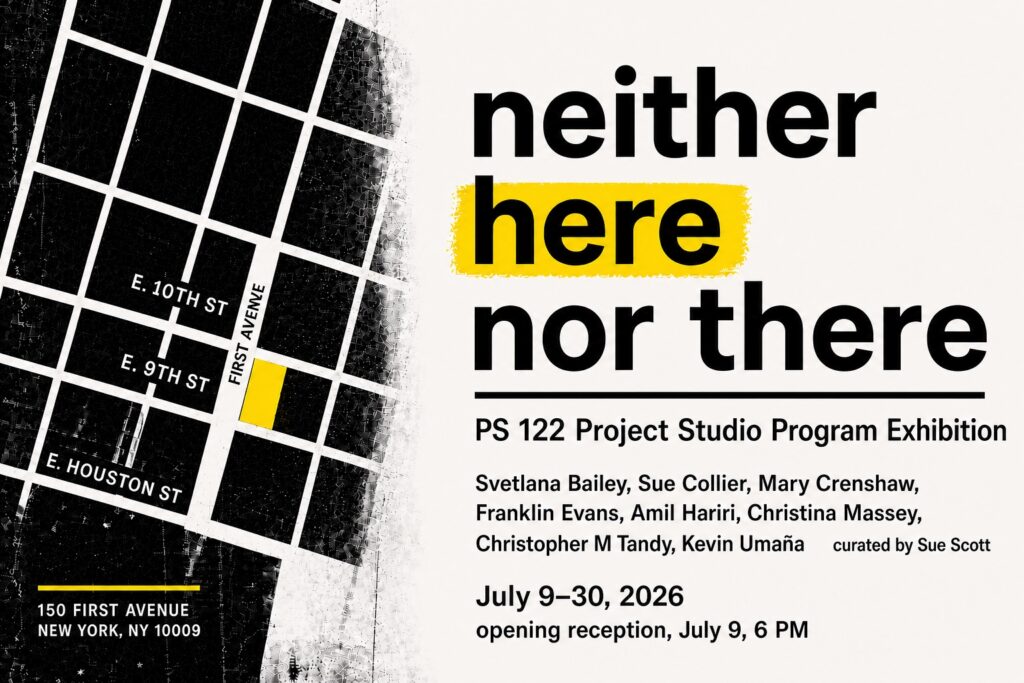
neither here nor there
Curated by Sue Scott
July 9 to July 30, 2026
The exhibition Neither Here Nor There features the work of the award recipients of the 2025-2026 Painting Space 122 Studio Program: Svetlana Bailey, Sue Collier, Mary Crenshaw, Franklin Evans, Amir Hariri, Christina Massey, Christopher M. Tandy and Kevin Umaña.
Neither Here Nor There borrows its title from an idiom that, in everyday speech, signals dismissal. That which doesn’t matter or is beside the point. The exhibition leans into that double meaning rather than away from it asking what gets relegated to “neither here nor there”: the in-between, the unresolved, the unorthodox.
To be neither here nor there is to be caught between places, belonging fully to neither. It can describe a physical displacement, a body moved across borders or held in transit, or an emotional response, an unresolved sense of where home is or where loyalty lies. It can also describe a way of working: a refusal to settle into a single style or category, a choice to remain free to move between abstraction and representation, between materials, between concerns. This exhibition takes that condition as its starting point rather than a problem to be resolved.
The artists weren’t chosen around a shared theme; they were chosen by the residency itself. What unites them here is a kind of structural restlessness. The title isn’t necessarily a description of absence; it’s looking at the possibility of what’s Neither Here Nor There. As John Cage once famously said, “When you start working everybody is in your studio – the past, your friends, enemies, the art world and above all, your own ideas — are all there. But as you continue painting, they start leaving, one by one, and you are left completely alone. Then, if you are lucky, even you leave.”
Svetlana Bailey photographs materials such as ice, fog, and decaying fruit that portray aspects of impermanence, environment and embodiment. The three photographs in this exhibition, Forty Trips, After Eating Fruit, and Hold On, are from a 2026 project in which Bailey cast body parts and used the molds to create sculptures out of ice which she photographed in various states of change. Like a modern-day memento mori, Bailey uses her still-life setups to examine the cycles of birth, life, and death.
Sue Collier has a theory that if she draws something, she will stop dreaming about it. For decades she has been haunted by the plight of migrants, and perhaps returning to the subject is a form of catharsis. The diptych Refugees merges this plight with intricate patterning inspired by exotic and historical wallpapers, depicting migrants not specific to any country, ethnicity, or image, but communicating a global condition. The cheerful palette and intricate patterning belie the desperate story being told. Collier’s use of vivid color is intentional: she wants viewers to see themselves in these figures, a recognition she believes would be harder to achieve if they were rendered in the muted greys and browns.
Mary Crenshaw’s ingenious collaboration with the poet and activist edre, entitled No Lamp in Lampedusa, continues her exploration of and interest in migration. The iPad drawings, played on a loop and overlaid with the poet’s voice, become animations allowing the viewer to experience the process and performance in real time. Four related drawings from the series Marked conflate the image of the target with outlines of the human figure and brightly colored gestural marks and drips, both joyous and ominous.
brainspaceextraction is a sampling from the immersive space Franklin Evans created over the past year in his studio. With each iteration, Evans cannibalizes his own work to more or less get inside a painting to create a new and different experience. Whether working in a gallery, museum or studio, Evans sees this as a continuum, a place where his art is ever evolving. Change happens through repetition, erasure, and a constant examination of self, art and its history, ideas, and all that has come before.
The works by Amir Hariri are part of a larger, ongoing project that takes Pablo Picasso’s Guernica, an outraged response to the 1937 bombing of the Basque town and the fascist forces behind it, as its point of departure. Hariri deconstructs Guernica, both literally and figuratively, to make cubistic paintings and sculptures that comment on bigger political issues like war, civil unrest and climate change. ShameMan, for instance, is a hybridized figure, part human, part animal, part machine, more Mad Max than Minotaur, depicting and shaming the notorious January 6th QAnon Shaman. Hariri extends his exploration of cubistic space in his mixed media ceramic pieces, reminding the viewer how form is constructed and how illusionistic space can be both visual and experiential.
Christina Massey uses found objects, specifically craft beer cans, to create contemporary weavings that are abstract but have conceptual underpinnings. Working on her own makeshift loom, Massey leans into the craft of weaving brought into mainstream art by Lenore Tawney and others, which in itself creates an interesting dialogue between the masculinity inherent in beer cans and the feminine tradition of weaving. The abstract composition is often informed by environmental elements. In Ebbs and Flows, for instance, Massey used climate data and weather maps to determine the matrix for her color and palette choices, with the metal strips painted to achieve this end. Collecting information and translating it into an experience through these readings may be part of the layering process, but for the artist the end result is more about an emotional response than an illustration.
The Apocalypse Has Already Happened by Christopher M Tandy is an updated form of assemblage that incorporates such diverse materials as bone, epoxy clay, interference paint, light, crystals, and road dust, to create a sculpture steeped in the mysticism of the past and the technological possibilities of the future. Imagine Lord of the Rings meeting Blade Runner. This corner wall sculpture is flanked by delicate wall drawings that can be read as body parts or abstracted sprites. Tandy’s interest in witchcraft and the possibility of communicating with other realms and beings becomes, in this pairing of sculpture and wall drawings, a way to explore the universal dilemma of what it means to be alive, and therefore what it means to be a creature that is dying.
Shadow of the Shape that Stayed by Kevin Umaña. continues the artist’s ongoing interest in abstract language as a means to explore personal history and cultural identity. From memories of his early years living in nature in El Salvador to urban life in Los Angeles and now New York, one can see a fusion of totemic imagery, modernism, city grids and the topography of nature. Umaña’s unique methodology combines varied materials and conflicting styles. Glazed ceramic plates, fired by the artist, are affixed to the canvas and painted with oil, acrylic and vinyl paint. Sand, salt or resin added to the paint changes the surface texture. The resulting visual shifts between matte and shiny, smooth and textured, creating a shallow space that changes the surface energy and recalling the shifting spatial forms of Synthetic Cubism. The imagery moves between hard-edged and biomorphic forms, and the narrative, familiar as if drawn from a collective memory, remains elusive.