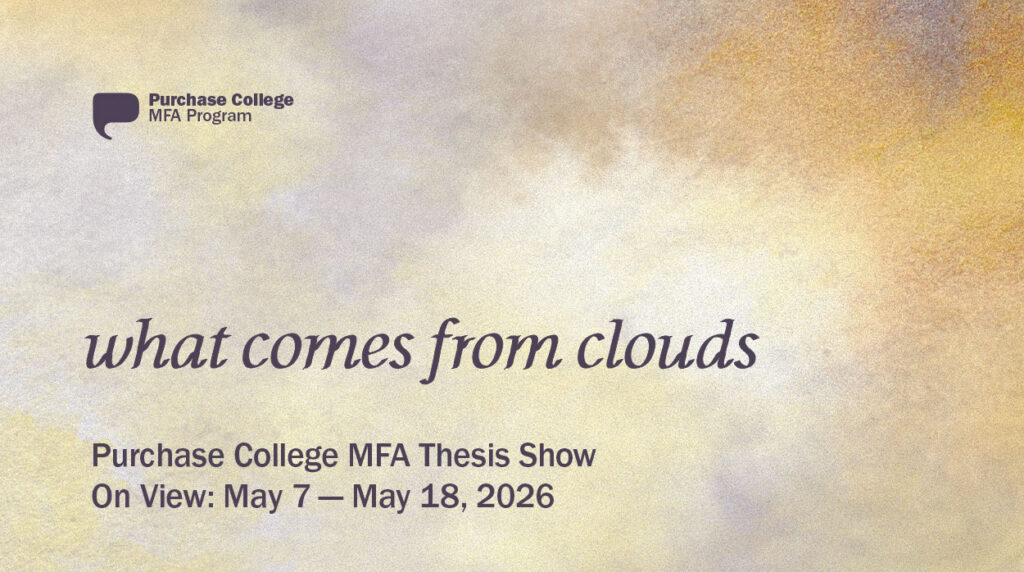
what comes from clouds
Purchase College MFA Thesis Show
May 7 – 18, 2026
What Comes from Clouds
by Julian Kreimer, MFA Chair
In the second paragraph of Ethan Frome, Edith Wharton summarizes the protagonist’s
college studies: “though they had not gone far enough to be of much practical use they
had fed his fancy and made him aware of huge cloudy meanings behind the daily face
of things.” 1 An MFA degree is rarely accused of providing excessive practical use, but
learning to interpret the complex meanings that lie beneath the surface is precisely what
these ten students have achieved.
More importantly, they have learned to work creatively within this cloudy, inchoate space
through their tight-knit community, trusting their instincts and ambitions without knowing
where each project will land.
Chris Borgia’s photos document his frequent walks along the Queens section of Robert
Moses’ Brooklyn-Queens Expressway. Small, colorful images of life occurring in the
highway’s shadows punctuate huge black-and-white prints of massive infrastructure.
Borgia has embraced playfulness as part of his artistic process: nailing prints right to the
wall, pasting them like billboards out-of-doors, and transforming his photo exhibitions
into low-relief installation.
Tanisha D’Souza wrestles buckets of paint onto enormous bolts of unstretched canvas
on the ground. D’Souza began her MFA making small, figurative drawings of
remembered and current lived-in spaces. Zany perspective folded an entire apartment
into a single view, in others, an empty armchair recurred: a metonym of loss. As rooms
led to windows led to gardens, D’Souza embraced a giant scale of canvases poured,
rubbed onto, and wiped off, inventing an alphabet of processes in which marks
paradoxically exist both abstractly and as evocations of personal stories.
Adrian Gray’s sculptural works seem to form part of a magical ceremony– found and
made objects combine into assemblages charged with a sense of sacred devotion.
Long, attenuated forms, like houses stretched tall, sprout branches from mud walls;
while commodities like sugar and fruits appear as signifiers of the complicated history of
production and trade in the Americas. These combinations seem tuned to the hallowed
quiet of what Gray terms “veiled places.”
Nyssa Juneau’s prints, drawings, paintings and frescoes combine an obsessive
reverence for techniques of the past with a confident hand that captures the vitality of
life lived in community. Through sketching she embeds herself amongst chess
devotees, subway riders, poker-players, flower sellers. These moments of quotidian
virtue defy the authoritarian politics of the present, their jaunty lightness a confrontation
to the shadowy present.
Bea Kaufman’s journey through the MFA program has seen her move from sculpture
and puppet-making to a raucous neo-Burlesque performance practice that teases
Jewish-American codes and characters. The conventions of burlesque—women
seductively disrobing onstage—become confrontations that puncture the audience’s
fixed ideas. In Burning Bush, Bea sets that eponymous bit of hair on fire, embodying the
heretical pun in an act that, a Feminist update of the vanguard Yiddish vaudeville
performers of the early 20 the century.
Raised Catholic in Italy, Gabriella Mazza has for years has followed teachings that join
Vedic and Christian spiritual traditions—an approach to the divine that finds form in her
exuberantly colored works. Laboriously tufted tapestries nod to vernacular altars while
depicting Goddesses reigning over transcendent realms. Spilling onto the floor like
altars, her sculptures update the powerful mythos of the sacred feminine power of the
universe.
Yuka Nakamura openness to new techniques at the start of her MFA combined with a
clear-eyed focus on the transcendent moments of everyday parenthood. Being a
Japanese artist living temporarily in the weird culture of suburban Westchester razor-
sharpened her focus: McDonald’s fry containers, the made-up world of dress-up, the
patterns of shadows cast by autumn leaves. Nakamura’s work distills temporal moments
into abstract shapes and lines that revealing the fullness of the empty spaces between
things.
Cnena Smith’s practice moves beyond boundaries. From colorful, affectionate pastel
portraits of loved ones to her sculpture of two figures that is both eerie and tender, her
work often spans mediums to convey a huge range of emotions. Works plumb the
agonies of war and frightful symptoms of the apocalypse that Smith was raised to
believe is impending, while making room for specific gestures of caring among her
friends, family, and loved ones.
Christian Wilbur reclaims the literary tradition of suburban anomie in his hometown of
Huntington, Long Island, a suburb designed for WWII veterans seeking domestic
isolation as a balm after communal wartime living. Wilbur’s photos capture the post-
pandemic souring of this geography of isolation, pointing to the absence of connection.
Figures in forested gay cruising spots evoke a poignant sense of furtive desire, while
penetrating portraits of family members present exhausted individuals stretched too
thin.
Animus Zhang’s works often present images of profound emptiness. Devoid of
narrative, Zhang’s mysterious photos present a world of spaces without people,
highlighting both architecture’s role as a “machine for living” and Zhang’s own unique
way of experiencing moments of pure perception stripped of emotions. In other works,
Zhang conjures a quiet sense of exile through juxtaposed ideograms, line drawings, and
a windswept seascape.
Despite their varied mediums, two shared themes emerge. First: the need for
connection, whether with people, animals, or a larger divine. Second, the close attention
of immersion in a process, whether it’s capturing photos that reveal mental states,
discovering shapes in the routines of family, coaxing embedded meanings from found
objects or long-ago traditions. Both a necessity in this difficult context, a cloud from
which we don’t know how we will emerge.
Artist Bios
Chris Borgia
Photographing from the perspective of a city dweller attuned to its transitional spaces, Chris
Borgia explores the overlooked thresholds of urban life. Borgia references Robert Moses’ urban
planning legacies by focusing on infrastructure initiatives designed to displace marginalized
communities, the connections between his family’s immigrant past during the late nineteenth
century, and his current experiences in New York City. We follow Borgia in considering how the
legacy of power, planning, and displacement continues to shape the city’s social and cultural
landscape.
Tanisha D’Souza
Tanisha D’Souza’s large-scale abstract paintings foreground form and texture over
representation. Working primarily in monochrome, she builds dynamic surfaces that balance
subtle tonal shifts with bold gestural energy. Drawing inspiration from the movements and
presence of her cat, her work evokes textures and rhythms that blur the boundaries between the
organic, the human, and the industrial.
Adrian Gray
Engaging with ideas and materials collected from the world around him, Adrian Gray explores
intersections between fantasy and nature. Working with common and organic objects, Gray
imbues them with abstract qualities, playing with how they take up space. Inspired by
abstraction, minimalism, and environmental art movements, he transforms objects through
whimsy and animism.
Nyssa Juneau
Influenced by her surroundings, Nyssa Juneau discovers beauty in the everyday. Drawn to vivid
color and subtle detail, she captures moments that might otherwise go unnoticed, inviting
viewers to pause and look more closely at the world around them, like a figure putting on a
green sweater. Working in fresco, a technique in which pigment is applied to freshly laid wet
plaster, she embraces both the immediacy and permanence of the medium. Each layer
becomes part of the surface itself, transforming fleeting, ordinary subjects into enduring
celebrations of the mundane.
Bea Kaufman
Bea Kaufman works across performance, video, and installation, treating the body as an archive
shaped by memory, inheritance, and lived experience. Her practice draws on Jewish cultural
histories, material experimentation, and acts of transformation that move between vulnerability
and spectacle. Through repetition, documentation, and disruption, Kaufman’s work challenges
fixed readings of identity, inviting audiences into moments that are at once intimate, unstable,
and insistently present.
Gabriella Mazza
Using vivid color and textile form, Gabriella Mazza creates dreamlike sculptures that re-imagine
traditional religious imagery. Having grown up in Italy, she draws from the rich visual culture of
Roman Catholicism, its rituals and symbols, while infusing them with her own language, and a
hint of the macabre. Mazza’s work becomes an act of custody, holding within it the memories,
contradictions, and emotional residue of belief.
Yuka Nakamura
Departing from the depiction of daily routines, Yuka Nakamura’s recent work turns toward
abstraction as a way of holding memory and emotion in color and form. Working primarily in
pastel hues, she captures the quiet calm of domestic life through soft gestures and shifting
tones. Her paintings could be considered acts of care, gentle spaces where traces of home,
rhythm, and recollection are preserved within layers of texture and light.
Cnena Smith
Cnena Smith creates art as both archive and aspiration, envisioning herself and her loved ones
within a future of peace and repair. Her sculptural collages give form to a deep sense of justice
and compassion, offering visual expression to voices that resist silence and suffering. Using
sentimental and sometimes unconventional materials, Smith weaves together fragments of
memory, emotion, and hope. Each piece becomes an act of holding, a tender preservation of
what is cherished, and a gesture toward the world as it could be.
Christian Wilbur
In a social landscape that often isolates, Christian Wilbur uses photography to examine identity,
masculinity, and the quiet solitude of suburban life. His images reflect a subtle dissatisfaction
with the world inherited from modernity and past generations, spaces shaped by both comfort
and emptiness. Through framing and stillness, Wilbur’s work holds traces of vulnerability and
introspection within environments that might otherwise go unnoticed.
Animus Zhang
Creation, analysis, and recollection are at the heart of Animus Zhang’s practice. Working in
drawing and video art, Zhang captures life through the lens of neurodiversity, translating
sensory experience into moving image and animated form. The in-between spaces of
supermodernity, those transient zones between presence and detachment, become both
subject and setting. Through these layered works, Zhang transforms fleeting moments into acts
of preservation, working against the speed and saturation of contemporary life.