
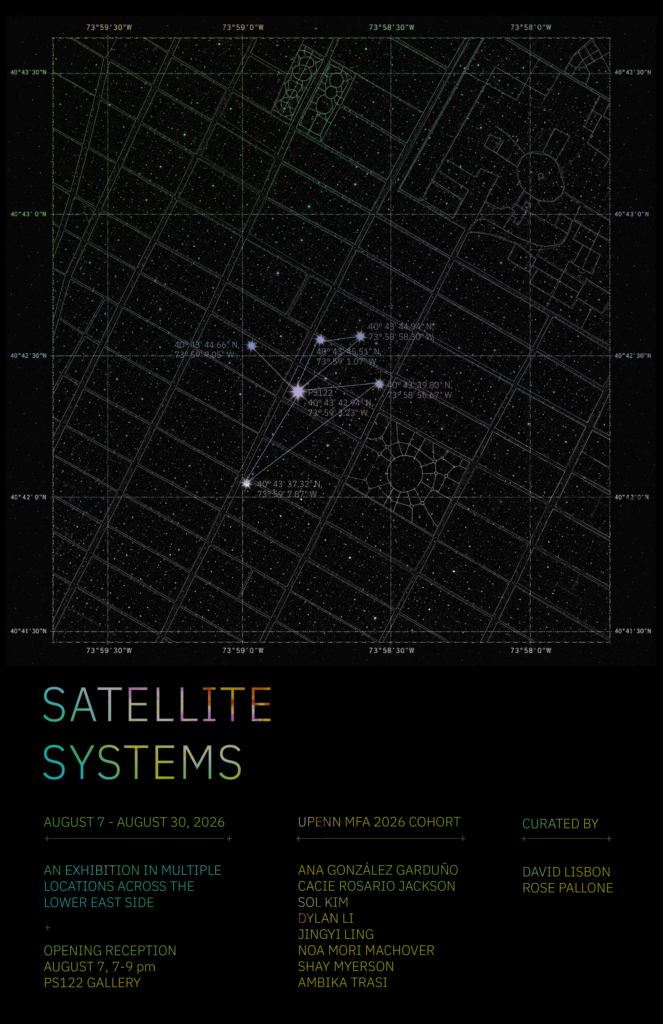
Satellite Systems
What does it mean to act on the world as it acts on you?
The works of eight recent MFA graduates from the University of Pennsylvania Stuart Weitzman School of Design (Ana González Garduño, Cacie Rosario Jackson, Sol Kim, Dylan Li, Jingyi Ling, Noa Mori Machover, Shay Myerson, and Ambika Trasi) generate private and public encounters with the systems that organize our world. By exploring both material and immaterial structures, such as historical archives, AI technology, language, and our senses, we are invited to use art as a vehicle for thinking through human experience and imagining new outcomes. The exhibition’s title—a play on the MFA program’s annual “satellite show”—is a metaphor for the way the world acts on us (through gravity, surveillance, regulation, etc.), working both with and against our attempts at forward momentum.
On view at PS122, Satellite Systems includes a diverse range of art forms, like sculpture, collage, drawing, and performance. Working within curatorial legacies that sought to radically shift an individual’s encounter with art, like Jan Hoet’s Chambres d’Amis (Ghent, June 21-September 21, 1986), we ask visitors to open themselves up to art’s wider social contexts by expanding the exhibition into public spaces in the East Village. These strategic encounters in further “satellite” locations like transit centers, laundromats, and record stores are an invitation to consider how art both shapes and is shaped by forces beyond us. The ideas investigated here—relationships between the body and environment, the invisibility of labor, slippage within perception, among others—bring attention to the conditions of our existence, using art to view these systems from alternative perspectives.
Ana González Garduño (b. 1999; Mexico City) is an artist based in New York City. She received her BFA from The Cooper Union in 2023 and her MFA at the University of Pennsylvania in 2026. Her portfolio consists mainly of drawings and sculptures.
Cacie Rosario Jackson’s work engages visual, sonic, and technological archives and recontextualizes them, creating new dialogues that speak to the ways Black performance, cultural production, and radio express transgenerational storytelling. Through photography, video, sound, and drawing, she employs methodologies of music intervention as practices of resistance, refusal, and recollection.
Sol Kim works across video, performance, photography, and installation, probing the gaps between lived experience and the linguistic, cultural, and technological systems that shape it. Through their practice, Kim creates simple, often performative gestures through which meaning slips out of the rigid rules and categories and transforms into something unexpected.
Dylan Li (b. Chongqing, China) is an artist working across performance, photography, video, and installation. Working in Philadelphia, his practice explores shifting relations between image, body, and space. He approaches image-making as a process of transfer, where accumulation, fracture, and erasure reshape visibility and identity.
Jingyi Ling is an interdisciplinary artist who works with sculpture, installation, and performance. Her works investigate the tension between power and space and collect moments of self-sovereignty in conceptual, spatial, and phenomenological ways.
Noa Mori Machover’s work reckons with what is too big to hold. Working across video, installation, cartography, sculpture, and writing, they trace the relations between earth (planetary and climatic forces) and world (the systems built to apprehend them: science, magic, capital, and myth). They follow, break apart, and reassemble materials and ideas, revealing how we, too, might be remade.
Shay Myerson is an artist working through sculpture, installation, and performance. Using decoys, pseudo-events, and artifacts of internalized threat, she builds systems where nature and artifice blur. Her materials: clay, metal, scent, and social choreography, become instruments for studying how attention, belief, and belonging take form, and how communities stage both survival and awe.
Ambika Trasi (b. 1988; Edison, NJ) makes installations and sculptures that call back to historical traditions of assemblage. By bringing together found and archival materials, images, and footage, she reveals how coloniality is encoded into objects and sites. She incorporates sound, video, and performance as modes of intervention in her installations to consider how the circulation of culture can shift and destabilize power dynamics.
Website: https://www.ambikatrasi.com/
IG: @atrasities