
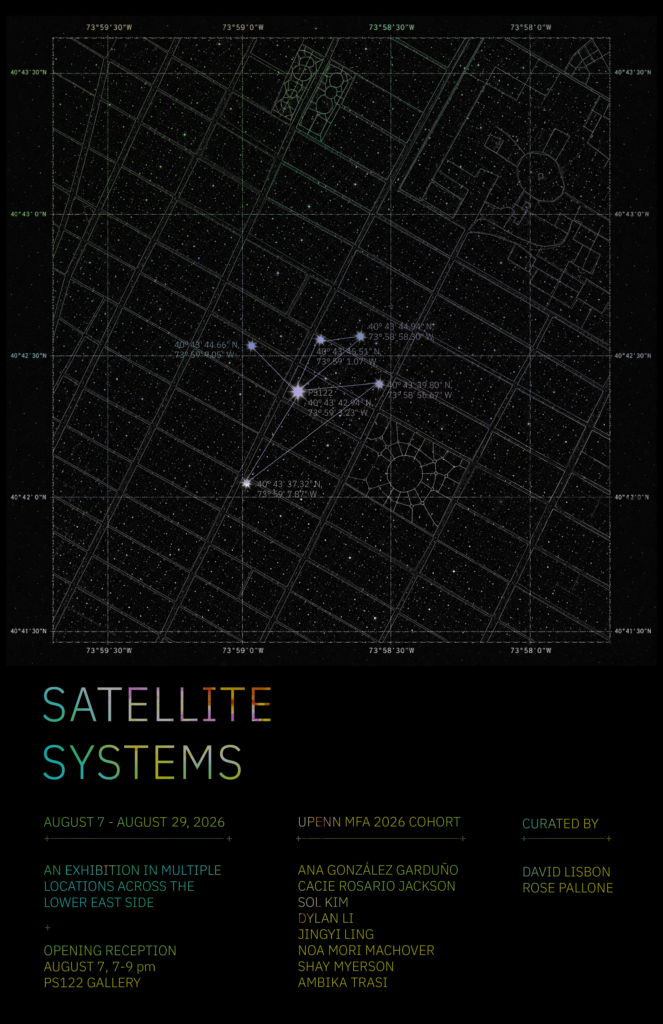
Satellite Systems
What does it mean to act on the world as it acts on you?
The works of eight recent MFA graduates from the University of Pennsylvania Stuart Weitzman School of Design (Ana González Garduño, Cacie Rosario Jackson, Sol Kim, Dylan Li, Jingyi Ling, Noa Mori Machover, Shay Myerson, and Ambika Trasi) generate private and public encounters with the systems that organize our world. By exploring both material and immaterial structures, such as historical archives, AI technology, language, and our senses, we are invited to use art as a vehicle for thinking through human experience and imagining new outcomes. The exhibition’s title—a play on the MFA program’s annual “satellite show”—is a metaphor for the way the world acts on us (through gravity, surveillance, regulation, etc.), working both with and against our attempts at forward momentum.
On view at PS122, Satellite Systems includes a diverse range of art forms, like sculpture, collage, drawing, and performance. Working within curatorial legacies that sought to radically shift an individual’s encounter with art, like Jan Hoet’s Chambres d’Amis (Ghent, June 21-September 21, 1986), we ask visitors to open themselves up to art’s wider social contexts by expanding the exhibition into public spaces in the East Village. These strategic encounters in further “satellite” locations like transit centers, laundromats, and record stores are an invitation to consider how art both shapes and is shaped by forces beyond us. The ideas investigated here—relationships between the body and environment, the invisibility of labor, slippage within perception, among others—bring attention to the conditions of our existence, using art to view these systems from alternative perspectives.
Born in Mexico City, Ana González Garduño is an artist based in New York who works with organic and found materials, observing how they react when subjected to different environmental conditions. Understanding art as an investigation of and through perception, Garduño’s drawings and sculptures explore forms of materiality that exist in both tangible and imaginary spaces. Her most recent body of work focuses on nuclear power plants, specifically spent fuel pools which are structures made to shield workers from invisible radiation. The mazes consist of cement chambers that both absorb and redirect particles—what is not absorbed reaches the exit. Radiation Maze (photograph taken in Lyndeborough, New Hampshire. August 1, 2026) (2026-ongoing) showcases sculptures made of cement and lard designed from floor plans for these spaces. Garduño’s application of organic materials to the mazes creates unstable objects that exemplify the interaction of radiation and cement. By recontextualizing the mazes outdoors, she considers the slow process of decomposition and calls attention to a New Hampshire state law which prohibits livestock from being buried within 100 feet of property lines or bodies of water. Like other works in Garduño’s practice that use artifacts from abandoned electrical substations, her Radiation Maze demonstrates an interest in peripheral or abandoned sites that can be reactivated with the senses.
Cacie Rosario Jackson’s artworks highlight the ways Black performance, music and radio pass stories generationally, reinforcing ideas of lineage and inheritance. Jackson’s soldering-iron-drawings, like Deep Space’s Roland TR-808, Roland TR-909, Casio-CZ101, Korg MS10 Drum Machines and Synthesizers (2026), borrow the visual language of circuitry from electric instruments and music players to make visible the social infrastructures, networks of migration, and oral histories she encounters in archival research. In addition to video and sound works, the artist explores these themes in photo-collages like Carr’s Beach (2025). Using repeated source imagery from the Black photojournalist Thomas R. Baden, Jr., Jackson envisions herself present at the legendary Chitlin Circuit venue as researcher, crowd member, and cartographer. Acknowledging the impossibility of archives to hold the entire story, Jackson’s artworks are an exercise in countermapping—elevating the visibility of marginalized histories and people over that of the nation-state—as well as an invitation to revisit “circuits” that function as vessels of memory in our culture to discover what more they can offer.
Instagram: @crosariophoto
Sol Kim is an artist working across mediums, including video, performance, and photography, to probe the gaps between lived experience and the linguistic, cultural, and technological systems that shape it. Kim’s latest installation Human-Centered AI (2026) mimics lawn signs that appeared on UPenn’s campus to promote an event of the same name, switching the original text for phrases like “Tree-Centered AI” and “Human Is Us.” The accompanying video functions as a mock advertisement for the event, intercut by clips of performers dressed in alien costumes. The aliens’ appearances are evaluated by an object-detection AI system that measures the probability of their being recognized as human. Like other examples of Kim’s work which place the artist’s own body in object-detection systems or attempt to determine the “cookiest” cookie, Human-Centered AI challenges the ways that human-developed categories are often imagined with certain boundaries in mind. This contradiction between machine vision and human activity encourages us to consider how categories have been used as a means of oppression and how when these rules begin to slip, we might reconfigure our human/nonhuman coexistence.
Instagram: @s0lk1m
Born in Chongqing, China, Dylan Li is an artist working with performance, photography, video, and installation to explore shifting relationships between image, body, and space. He approaches image-making as a process of transfer, where accumulation, fracture, and erasure reshape visibility and identity. Li’s self-produced documentary Boundary Between Fog and Cloud (2021-2024) presents the history of transition from the Kingdom of Muli to the Muli Tibetan Autonomous County, highlighting the survival and current state of Tibetan Buddhism. Through the artist’s community collaboration, the documentary also shows the life of the Mosuo people in Lijiaju Village under the multi-ethnic governance of the Muli Kingdom and how they continue their indigenous cultural practices and grapple with their identity in the context of modernization. Boundary Between Fog and Cloud extends Li’s interest in photography and film as an unstable mode of perception that is shaped by time, position, and attention. Through his research, he makes these structures visible and capable of loosening.
Instagram: @dylanliiii
Using transparent materials like water, light, silkscreen, and plexiglass, Jingyi Ling is an interdisciplinary artist whose works investigate what it means to conceptually and physically move through or within a space. Universe Toaster (2025) is a recent video work departing from the scientific joke and philosophical metaphor that the universe is a toaster—or that thermal radiation corresponds to only a narrow band of visible light, most of which, unseen yet ever-present, surrounds us. In a dimly lit kitchen, the artist attempts to transmit the word “SUN” to the universe using the language of quantum key communication. The encrypted signal, originally carried by photons, is absurdly displaced onto patterns burned into the surface of toasted bread. The accompanying soundtrack, which is drawn from Russian composer Modest Mussorgsky’s existentialist vocal suite Sunless (Bez Solntsa), was reworked and reshaped through the artist’s own sound editing. Like much of Ling’s work that seeks to intervene with and make visible the rhythms and architecture a room contains, Universe Toaster draws a thread between the domestic and the cosmic—inviting viewers to reconsider the nature of the spaces we inhabit.
Noa Mori Machover is an artist, designer, and researcher working across video, installation, cartography, sculpture, and writing. Their work follows materials and ideas through the systems (markets, rituals, laws, and myths) that give them value. The work on view at PS122, the air itself could speak (2026), is a wind machine apparatus—a barrel with fans attached, blowing at variable speeds. The internal airflow is made visible by a grid of tethered strings, modeled after those used in automotive aerodynamic testing, and by platinum blonde hair streaming from the back like exhaust. The strings and hair rise, still, and tighten as the fans’ velocities respond to live platinum and palladium spot price data, scraped in real time. Viewers peer through the window of a 2009 Toyota Prius, which is among the cars most targeted for catalytic converter theft due to the precious metals it contains. In theft follows value (faster than it ever follows the law) (2026), a catalytic converter fragment extends this inquiry in the neighboring Saifee Hardware & Garden store, the sale price fluctuating in kind with the same live data. The continuous fluctuation of commodities trading remains in an unstable state, making visible the volatile interdependency between economic and political systems and inviting us to consider how such relationships might be remade.
Instagram: @noa.mori
Shay Myerson is an artist working across sculpture, installation, and performance to examine how ordinary technologies become instruments of attention, behavior, and belief. In two related sculptures installed at PS122 and the nearby Russian & Turkish Baths, Myerson uses industrial slow-feeder hay bags (devices designed to regulate an animal’s access to food) as a sculptural framework to further develop ideas from the artist’s recent video Threshing Floor/General Assembly (2026). The threshing floor—where wheat is separated from its outer husks—functions both as a site of agriculture and a space of revelation and collective transformation in early religious and ethical texts. In your horse will take smaller bites (wet) (2026) and your horse will take smaller bites (dry) (2026), Myerson replaces the contents of slow-feeder bags with photographic renderings of hay printed on fabric. Together, the works create a landscape where repetitive labor, collective perceptions, and psychic contagion begin to overlap. The slow-feeder turns the horizontal logic of the threshing floor into a vertical object (and as a result, an object of circulation and display), suspending it within the visual economies of the American landscape.
Ambika Trasi makes installations and sculptures that call back to historical traditions of assemblage. By bringing together found and archival materials, she reveals how coloniality is encoded into objects and sites. Continuing her research into electronic music and organs, Trasi’s video installation Oblation (2026) explores how modularity in synth music is tied to code-switching and racial politics in the United States. The work considers the Black American composer, organist, and mesmerist Korla Pandit. Born in Missouri in 1921 with the given name John Roland Redd, he began performing as Korla Pandit after moving to California in the 1940s, claiming to be a French-Indian musician from New Delhi in order to bypass strict segregation laws. Excerpts of Korla’s numerous television appearances appear in Oblation, alongside video footage of the Mechanical Turk—an 18th-century chess playing machine operated by a person pulling levers underneath a cabinet. Like the Mechanical Turk, Redd’s use of passing was a hoax predicated on the white orientalist gaze. Oblation, which is set to audio tracks by Gita Sarabhai, Charanjit Singh, John Coltrane, and Alice Coltrane, takes a hybrid form decorated with piano organ parts, a gramophone horn, and other objects referencing musical histories and Hindu pooja offerings. Meanwhile, Trasi’s NYC / TLC, installed at United Shipping & Packing (200 E 10th St) considers the Lower East Side’s shipping station as a hub for cultural exchange for diasporic New York City residents and workers. Made from a hub cap and embellished with a taximeter, the iconic New York Anthora paper coffee cup, Parle-G biscuit wrappers, and Bollywood cassette tapes, the work acts as a tribute to local New York City taxi drivers and the local LES sites like Punjabi Deli, that have acted as safe havens for immigrant workers and sites for union organizing. They rely on such shipping stations for essential imports to sustain them. Trasi’s research-based works seek to become third spaces wherein abstraction and hybridity act as tools to counteract and reshape established structures, allowing for new possibilities to emerge.
Instagram: @atrasities